
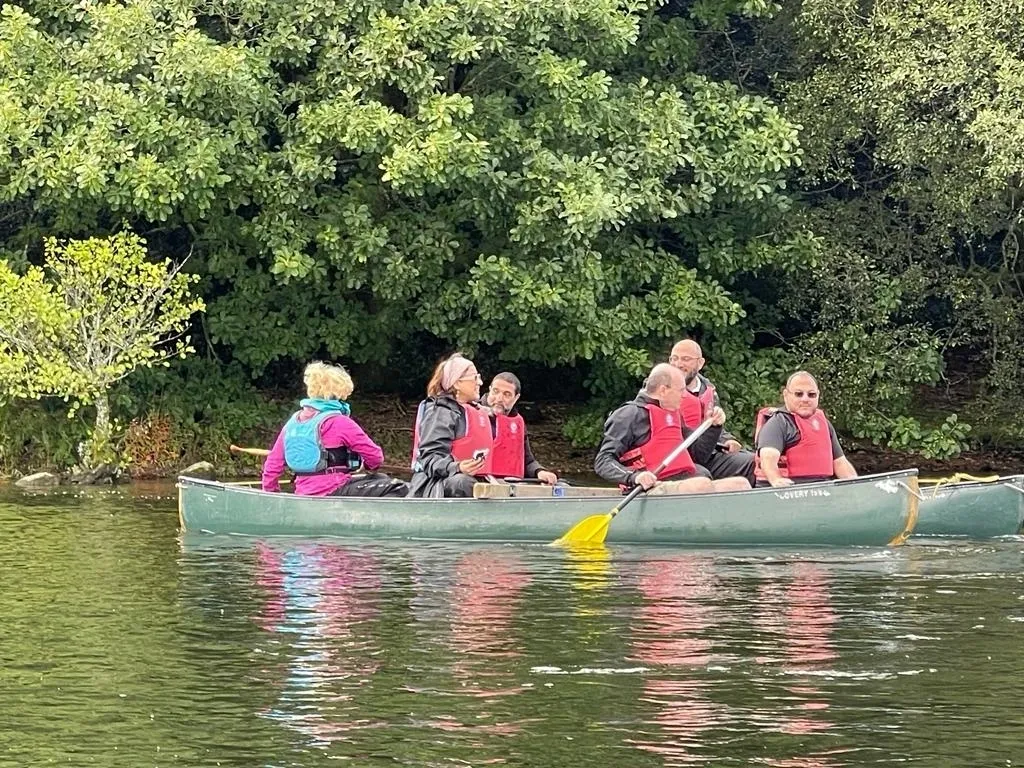
My journey into embodiment did not begin with textbooks or theory — it began in a canoe.
On Grasmere Water, during the International Masters Program for Managers (IMPM)’s https://impm.org Mindset module, I found myself balancing on cold water while listening to Wordsworth. That moment — physical, sensory, completely lived — became my first understanding that learning is not only something the mind does. It is something the body knows.
 canoeing in the Lake District
Throughout the IMPM, I kept encountering knowledge through experience: walking through the Quaker Meeting House in Brigflatts, lighting a candle in a cave, wearing a kimono in Japan, and navigating Bengaluru’s streets while “walking like a cow.” These were not metaphors for learning — they were learning. They shaped my understanding of management and leadership far more deeply than any static classroom instruction ever could.
That realisation led me deeper. I wanted to understand why embodied experiences were so transformative. This inquiry became my Master’s Degree Major Paper, then my MISSC rubric (Fatani, 2025) (Mobility, Interaction, Somatic Integration, Space, and Cognitive Engagement), and now the foundation of my PhD.
As I explored embodiment — from phenomenology to somatic philosophy to embodied cognition — I realised I wasn’t just studying embodiment.
I was living it.
That is where the word Embodyography emerged.
Embodyography is embodied autoethnography: the documentation of knowledge as it is lived, moved, sensed, and experienced through the body.
(A definition I am still shaping — because it must be lived to be understood.)
This blog is my way of capturing that journey — my PhD in Lancaster University in the UK as an embodied practice. It is not only about the MISSC framework I developed to create, measure and now document embodiment, but about the everyday moments, movements, reflections, practices, art, spaces, and sensations that shape how I learn, research, think, and become — with my whole self: body and mind together.
In the next posts, I will begin unfolding this journey — starting with Mobility, the first MISSC driver, and the one that continues to anchor both my thinking and my movement through this PhD.
Welcome to the journey.
Welcome to Embodyography.
Fatani, R.H. (2025) ‘Embodiment in Management Education,’ McGill University, May.
Reflections
0
